



MODULE 2145 - FILTER CONTROLLER
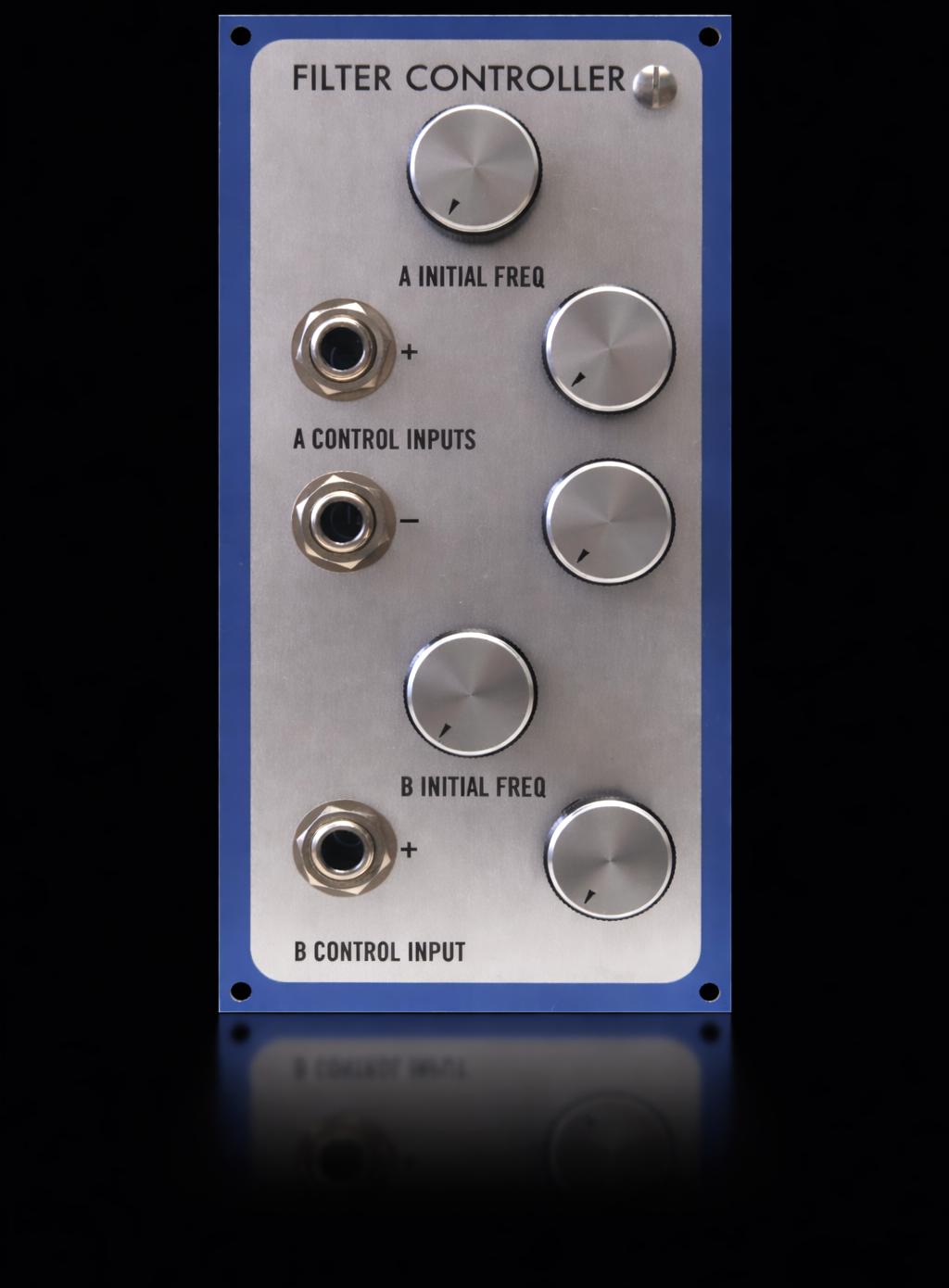
The 2145 Filter Controller allows voltage control of the frequency of two banks of 2140 Resonant Filters. Each bank of filters may contain from one to four 2140 units. The bank center frequency will be determined by the 2145 controller while the formant shape will remain unchanged. The “A” section initial frequency control alters the frequency of the “A” filter bank by +5 octaves. The “A” section “+” control input will shift the frequency of the “A” bank with a maximum sensitivity of 1 volt/octave, depending on the setting of the adjacent attenuator. The “-” control input will similarly shift the “A” bank, but will respond to a positive voltage with a negative frequency shift. The “B” filter bank is similarly controlled by the “B” section initial frequency control and the “+” control input.

When no external patch is made to the “-” control input in the “A” section, this is pre-patched to the control output for the “B” section. Hence, with the attenuator turned up, rotation of the “B” section initial frequency control, or applying a voltage to the “B” section “+” control input will shift the “B” bank up in frequency while shifting the “A” bank down, an interesting stereo musical effect.
Panel size : 1 Width Unit
Power Requirements : ±15 V @ 10 mA typical
Price : 200€
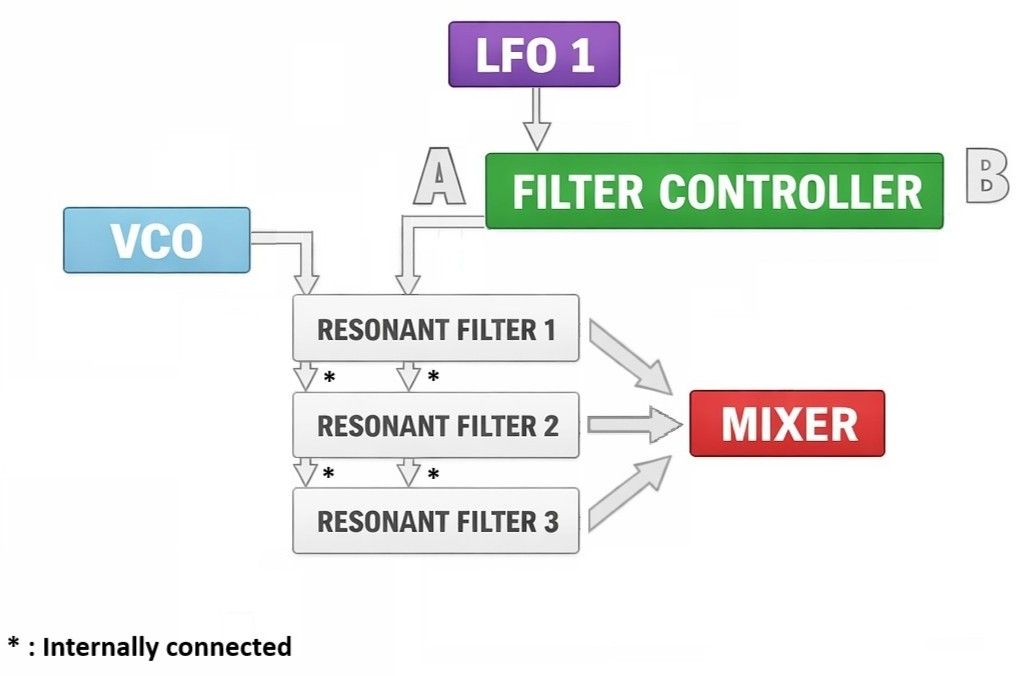
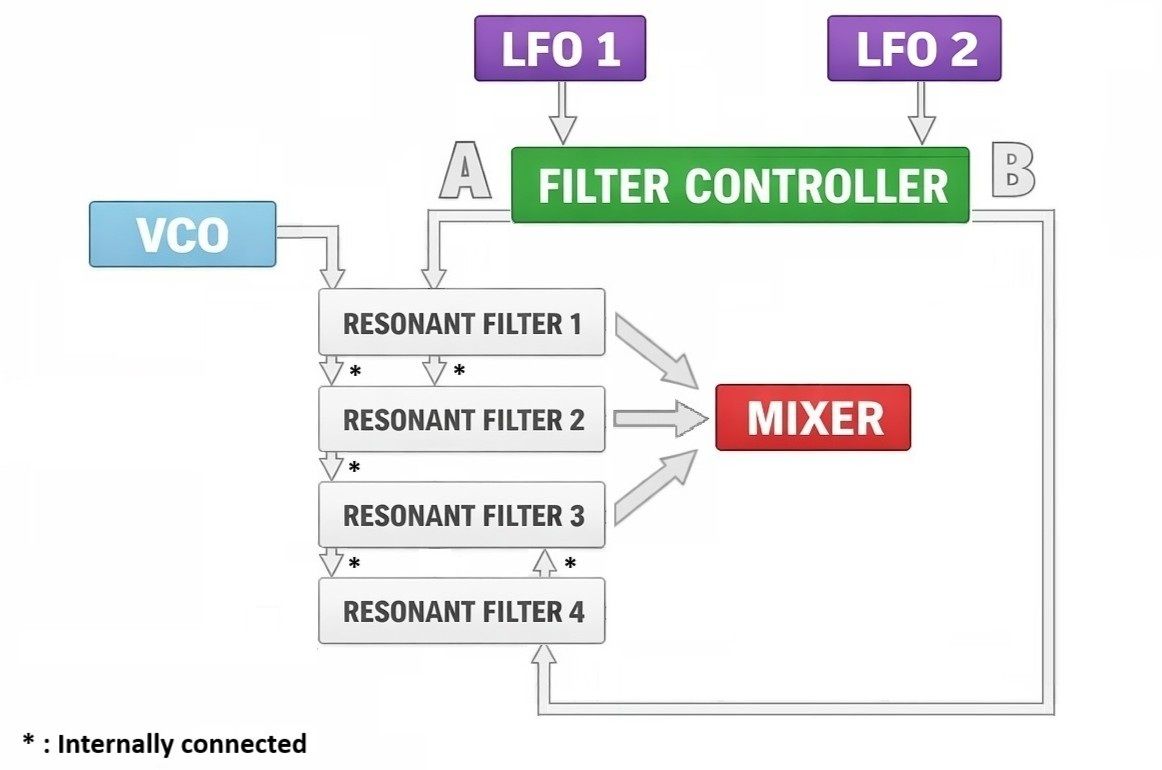
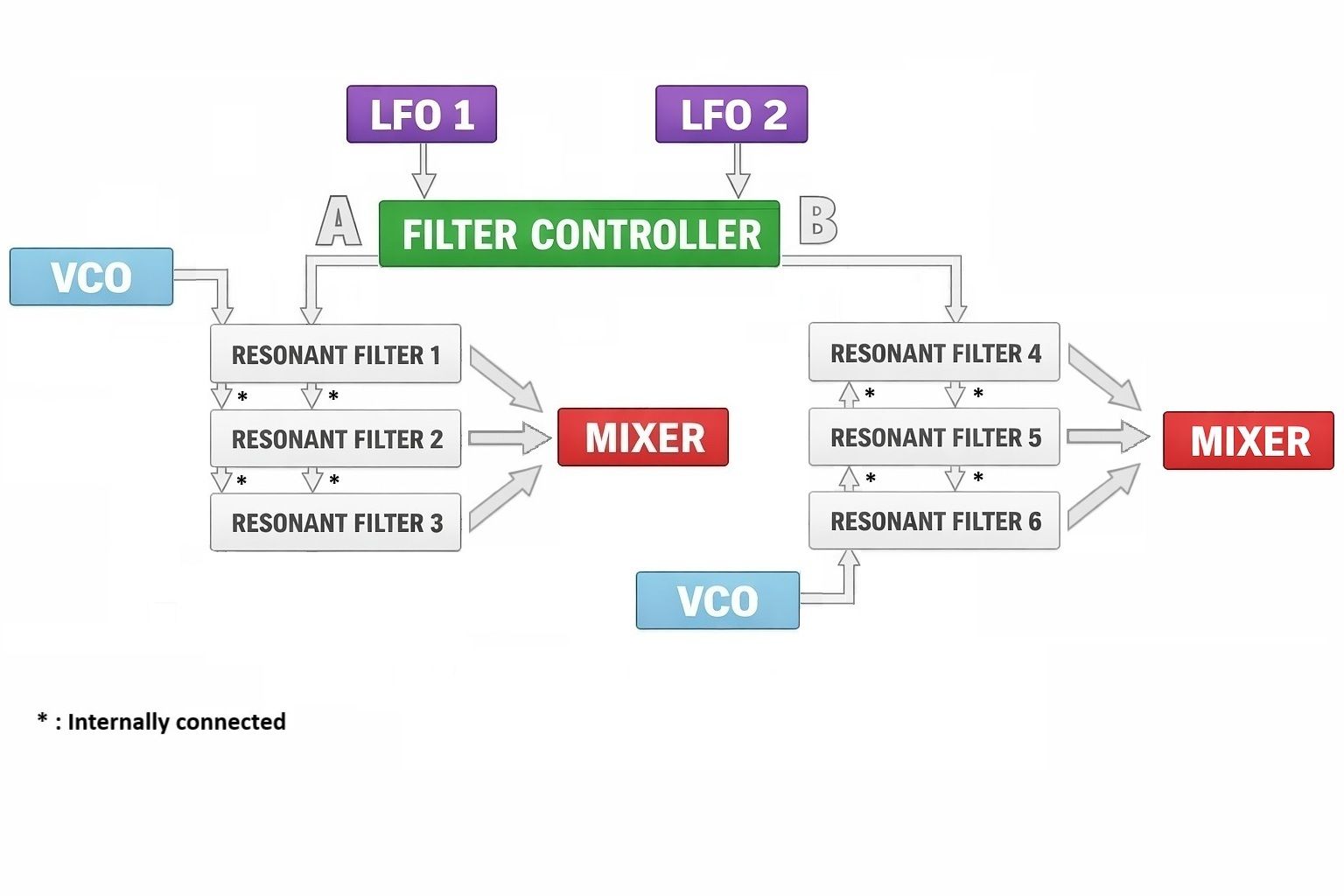
A few examples of parallel connections between the 2145 module and several 2140 modules are shown below. Many configurations are possible, offering a wide range of combinations and sonic results.
In the case of cascading several 2140 Resonant Filter modules, the first module operates as the master, while the following modules operate as slaves.
An internal interconnection, implemented at the factory, allows the distribution of audio signals (originating from one or more VCOs) as well as control voltage (CV) signals (coming from one or more modulation sources) to the different modules involved.
The 2145 module provides two separate outputs (A and B).
These outputs are internally connected and distributed according to the configuration defined during assembly.
This arrangement cannot be modified without opening the unit and reconfiguring the internal wiring.
Copyright © 2026, MOS-LAB . All Rights Reserved.